
Performance Management vs Performance Reviews: Why Employers Need to Stop Confusing the Two
Many organizations believe they have a solid performance management strategy because they conduct annual performance reviews. Goals are set, forms are filled out, ratings are assigned, and conversations happen — once a year. Then leadership wonders why engagement is low, high performers leave, and managers feel uncomfortable delivering feedback.
Here’s the truth: performance management and performance reviews are not the same thing. In fact, treating them as interchangeable is one of the most common — and costly — people management mistakes employers make.
Performance reviews are a single event. Performance management is a continuous system. When companies rely too heavily on reviews and neglect the broader performance management process, employees feel disconnected, managers feel unsupported, and organizational goals suffer.
This article kicks off a four-part series on performance management for this month, where we’ll explore:
Why just performance reviews aren’t enough for your team
How to catch performance issues early… before giving a PIP
How to coach underperforming employees without hurting morale
Common reasons why feedback systems fail (and how to be proactive)
Let’s start with the foundation.
So What Is Performance Management?
Performance management is an ongoing, strategic process designed to align employee performance with organizational goals. It’s not a once-a-year task — it’s a continuous cycle of planning, coaching, feedback, development, and evaluation.
At its core, performance management answers three essential questions for employees:
What’s expected of me?
How am I doing right now?
How can I improve and grow?
A strong performance management system typically includes:
Clear role expectations and success metrics
Regular one-on-one check-ins
Real-time feedback and coaching
Goal setting and adjustment
Skill development and career growth conversations
When done well, performance management becomes part of daily leadership — not a dreaded HR obligation.
This idea closely aligns with why clear performance metrics are critical for team success, as outlined in The Importance of Clear Performance Metrics for Your Team’s Success
What Is a Performance Review?
A performance review is a singular formal evaluation, usually conducted annually or semi-annually. It summarizes past performance, assigns ratings, and often influences compensation or promotion decisions.
Performance reviews typically involve:
A standardized evaluation form
Manager-written feedback
A retrospective focus on past behavior
Limited employee input
High emotional stakes
While reviews can provide structure and documentation, they often fall short when used as the primary performance tool. Employees receive feedback too late to act on it, and managers struggle to recall specifics from months earlier. Until a time machine exists, this just isn’t a practical way to improve performance.
In short, performance reviews are a component of performance management — but not the system itself.
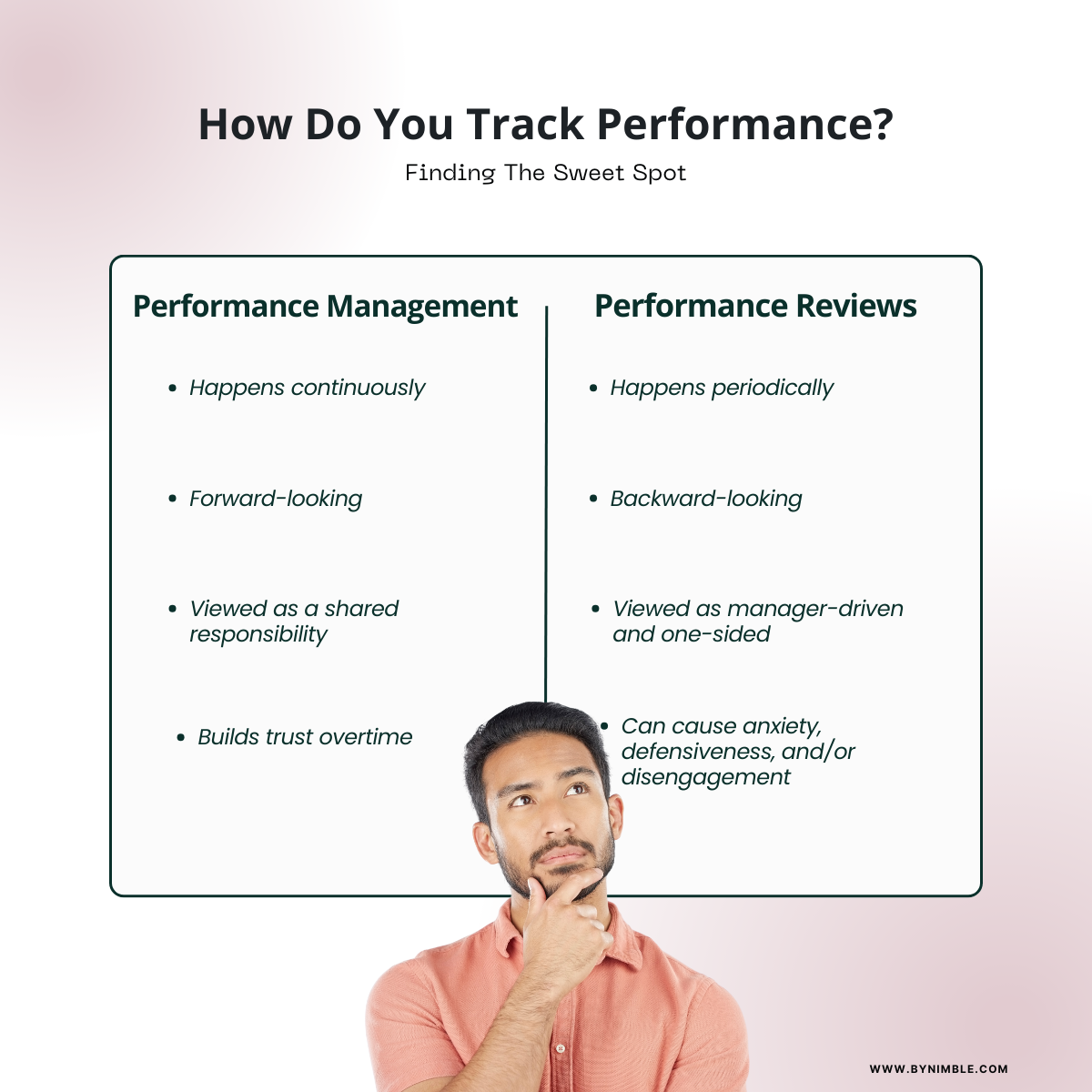
Performance Management vs Performance Reviews: Key Differences
Frequency
Performance management happens continuously. Performance reviews happen periodically.
Employees need feedback in real time to adjust, improve, and stay engaged. Waiting 6-12 months creates gaps that lead to lack of communication, frustration, and missed opportunities.
Focus
Performance management is forward-looking, emphasizing growth and improvement. Performance reviews are backward-looking, focused on what already happened.Modern employees — especially high performers — care more about development than ratings.
Ownership
Performance management is a shared responsibility between managers and employees. Performance reviews are often manager-driven and one-sided.
When employees actively participate in goal setting and feedback conversations, accountability and engagement increase.
Emotional Impact
Performance management builds trust over time. Performance reviews often trigger anxiety, defensiveness, or disengagement — particularly when feedback is unexpected.
This dynamic contributes to broader cultural issues, including micromanagement and disengagement, as discussed in 7 Ways Micromanagement Destroys Your Company Culture .
Why Confusing the Two Hurts Your Organization
When companies equate performance reviews with performance management, several predictable problems emerge:
Feedback becomes rare and high-stakes
Managers avoid difficult conversations
Employees feel blindsided by reviews
High performers disengage or leave
This confusion also contributes to employee turnover — a costly issue we explore in The Hidden Costs of Employee Turnover.
Without ongoing feedback and development, employees don’t feel invested in (and they eventually look elsewhere).
Why Performance Management Matters More Than Ever
Today’s workforce expects transparency, growth opportunities, and regular communication. Annual reviews alone cannot meet those expectations.
Effective performance management supports:
Stronger manager-employee relationships
Higher engagement and productivity
Clearer alignment with business goals
Improved retention and morale
It also reinforces consistency in leadership practices — a cornerstone of healthy workplace culture. For further reading, check out Why Consistency in HR Management Is the Secret Sauce for Building a Great Company Culture.
What’s Next?
This post lays the groundwork by clarifying the difference between performance management and performance reviews. In the coming weeks, we’ll dive deeper into:
What modern performance management systems look like in practice
How to build a sustainable approach that drives results — not resentment
Each article will build on the last, culminating in a final post that ties the entire series together. Follow us on LinkedIn to stay up to date.
Conclusion
Performance reviews are not inherently bad — but they’re not enough. Without a broader performance management system, reviews become isolated events that do more harm than good.
Organizations that shift their mindset from “review season” to continuous performance management create cultures of accountability, growth, and trust. That shift doesn’t happen overnight, but it does start with understanding the difference.
About the Author
Alex Santos is the founder of Nimble Advisors, a team of HR professionals providing human resource consulting services for small and medium-sized businesses. With a passion for people strategy and optimizing businesses to perform better, his team dedicates themselves to working with SMBs across Florida and nationwide.
Frequently Asked Questions
-
Performance management is an ongoing process that includes goal setting, feedback, coaching, and development throughout the year. Performance reviews are a single, formal evaluation event that looks back at past performance. Reviews should support performance management — not replace it.
-
Annual reviews can still be useful for documentation and compensation decisions, but they should not be the only feedback employees receive. Most organizations benefit from pairing reviews with regular check-ins and ongoing feedback. Without that balance, reviews often feel outdated and ineffective.
-
Many employees dislike reviews because feedback feels delayed, unexpected, or overly focused on ratings. When conversations only happen once a year, trust erodes and anxiety increases. Regular performance conversations help reduce those issues.
-
Managers should provide feedback frequently — ideally through weekly or biweekly check-ins. Feedback doesn’t need to be formal to be effective; timely, specific conversations are often the most impactful. Consistency matters more than length.
-
Without a system, expectations become unclear, feedback is inconsistent, and development stalls. Over time, engagement drops and turnover increases. A structured approach helps align people, performance, and business goals.